

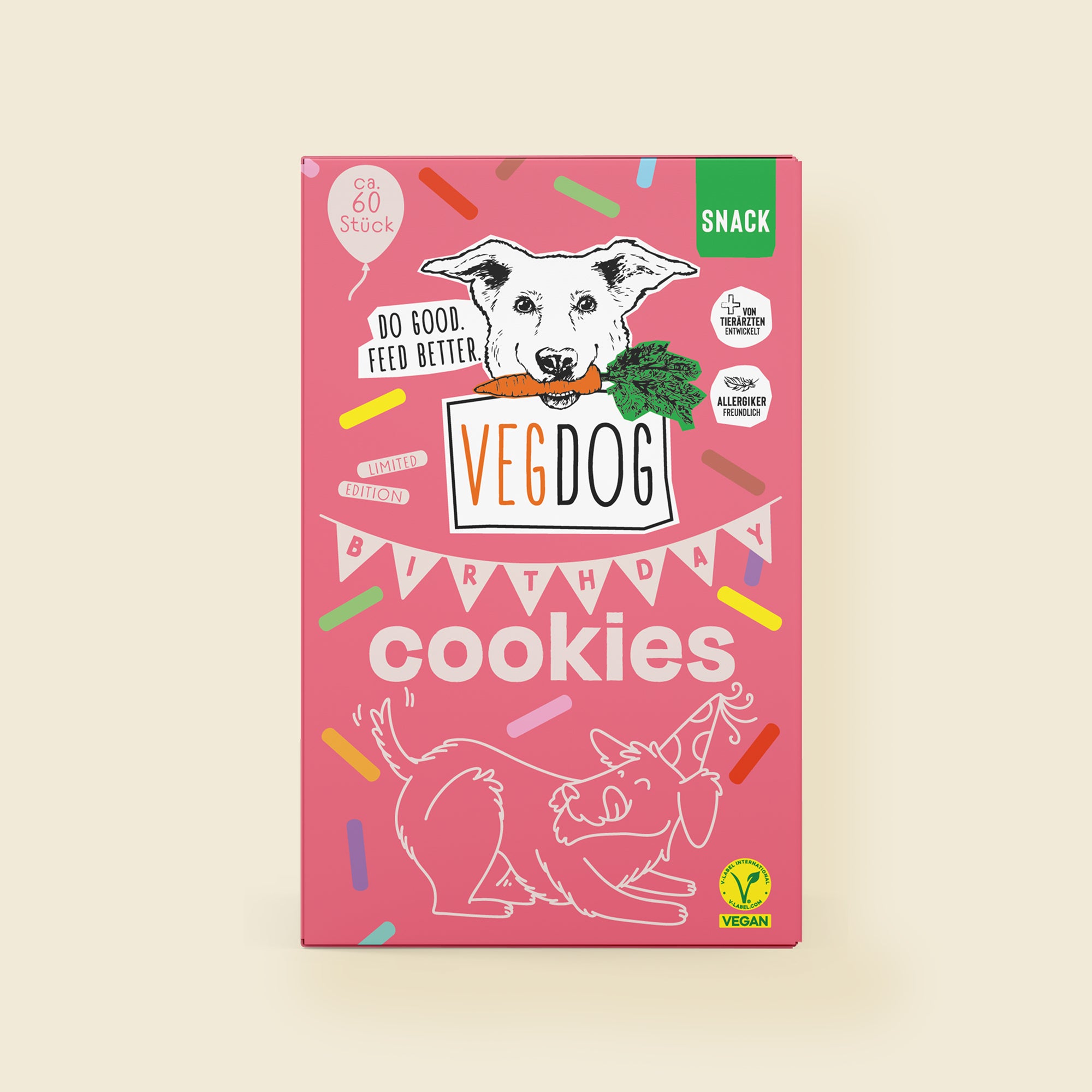

Vegan dog – Actually healthy?!
Most of you are surely familiar with the usual prejudices: “A vegan diet for dogs?!? That can’t be healthy! It lacks meat, protein! What about the vitamins? That’s unnatural! There must be deficiency symptoms! It’s unhealthy!
 Author: Carla
 Proofreader: Veronika
Most of you are surely familiar with the usual prejudices: "Vegan dog food?!? That can't be healthy! It's missing meat, protein! What about the vitamins? That's unnatural! There must be deficiencies! It's unhealthy!".
The fact is, a dog does not need meat itself, but rather the nutrients contained within it. These can also be provided to the dog on a plant-based basis... you just have to know how! We at VEGDOG are frequently confronted with these statements. This is reason enough for us to shed some medical light on vegan dog nutrition for you. Furthermore, we would like to offer a recommendation as to which tests actually make sense for your vegan-living four-legged friends and how you can ensure that they have a long and healthy vegan life ahead of them.
First and foremost, a precise examination of the administered ration should always be the priority.
Do you feed a commercial food?
Is it declared as a complete feed?
Then the requirements for all substances important for the dog should actually be met. Unfortunately, there are always black sheep among feed manufacturers here as well. Some of these feed manufacturers label their food as complete food, but fail to supplement it with essential additives.
With a vegan complete feed, for example, the addition of carnitine and taurine, vitamin B12, copper, zinc, as well as raw materials containing EPA and DHA is necessary. Whether these are truly essential is not yet proven. We recommend taking no risks here, however, and for this reason, we add them to all our feeds.
It is a different story when the vegan meal is prepared at home for our furry friends.
Here, one can unknowingly do a lot of things wrong. The reason for this is a lack of knowledge about the nutritional physiological needs of the dog. However, this has nothing to do with a vegan diet. After all, the dog does not need the meat itself, but its components. These can be provided just as well through various plant-based ingredients.
Anyone who decides to cook their own food or feed raw can unknowingly fall into several traps.
Our dear four-legged friends have a basic need for many different nutrients, minerals, trace elements, and vitamins. This must be met and varies depending on age, physical condition, and health status. If there is an undersupply or oversupply, the dog's body compensates for this for a very long time, usually for many years. Changes in the blood count are then usually not yet recognizable. The status quo in the blood is maintained at the expense of various organ systems.
If symptoms of malnutrition eventually appear, it is high time to rethink your own feeding habits.
Signs of poor supply can be diverse. A deficiency in copper, zinc, and various vitamins, for example, manifests itself in an unhealthy-looking coat and a reduced immune system.
Bone deformations or even fractures occur with an incorrect supply of calcium and phosphorus. Too much iodine leads to an overactive thyroid—the dog loses weight. Too little iodine has the opposite effect.
We are "loath" to recommend having various expensive blood profiles done to detect nutrition-related diseases. These are often not very meaningful and make it difficult to see whether there is a deficiency. In our eyes, the money is better invested in a specialist (veterinarian with the additional qualification "Nutritional Counseling for Small Animals") who can create a balanced and needs-based ration for your dear four-legged friends or check your current feeding habits. This gives you peace of mind that your dog is not suffering from any deficiencies and can lead a long, healthy life. The blood count would be secondary in this case.
If you still want to have something tested, it is best to opt for a comprehensive blood panel. In addition to blood and inflammatory cells, organ parameters can also be identified here. With elevated thyroid values, you can prick up your ears and ask yourself what your dog's iodine supply looks like. Kidney values tell you whether there might be too much strain due to overdosing on various substances. A disproportionately high content of protein and/or phosphorus in the ration is particularly burdensome here. And the liver, as the dog's main metabolic organ, will sooner or later (sometimes unfortunately too late) reveal whether something is amiss. Here, too, a high protein content (especially if it is difficult to digest) is counterproductive. A lot of vitamin A and copper also put a strain on the liver, as these are metabolized there.
Of course, this is often preceded by underlying diseases, which, however, can be significantly influenced (positively and negatively) by the composition of the food. It is also possible to have the content of calcium, phosphorus, zinc, copper, vitamin B12, and the like checked in the blood. As already mentioned, however, values in the reference range can mask a poorly composed ration and only lead to problems after a longer period of time.
Here you will find the most common traps one can fall into when cooking a vegan ration yourself:
- Transferring human needs to dogs: Dogs and humans have fundamentally different requirements for most nutrients. For this reason, feeding human rations is unfortunately completely unsuitable for our four-legged friends.
- The much-discussed protein is a key point in the vegan diet of our dogs. Not only meeting the requirement but also the composition of the amino acid profile is decisive.
- The calcium-phosphorus ratio is ideally 1.3:1. Calculating this is not entirely easy and should be left to a specialist. The level of calcium and phosphorus in the blood is kept constant for a long time, even with incorrect nutrition. Bones and other structures from which the minerals are drawn then suffer.
- Copper and zinc are trace elements that are missing in most home-prepared rations. They are usually not present in the required amount in natural feedstuffs and must therefore generally be added. A deficiency becomes noticeable after some time through a dull coat.
- Iodine occurs in various algae. These contain the essential trace element in such abundant quantities that an oversupply with a negative effect on the thyroid often occurs.
- A deficiency of B vitamins is not uncommon. This is a pity, as these cannot be overdosed, and an excess of B vitamins is simply excreted. The addition of these health boosters is therefore safe.
- Every prepared ration should have approx. 1g/kg of high-quality oil (linseed oil, thistle oil, borage oil, evening primrose oil,...) added, as only these contain the essential fatty acids. Since this entails many calories, the remaining components of the ration must be reduced.
- Ill animals have different requirements for various substances and must therefore always receive a ration tailored to their health condition!
- Puppies forgive dietary mistakes much less easily than adult dogs! They are in their main growth phase, have an increased need for protein, and can develop permanent bone deformations due to deficiencies in calcium and phosphorus supply!!!
If you have questions about your rations, please do not hesitate to ask them at tierarzt@vegdog.de.
Your VEGDOG Team
