
Cooking vegan for your four-legged friend – how do you get everything into the bowl?
What exactly ends up in the food bowl?
Those who want to know for sure pick up the wooden spoon themselves. It is important that the four-legged friend is provided with all essential nutrients according to their needs. For this reason, one should give comprehensive thought to the dog's nutritional requirements in advance.
 Author: Alena
 Proofreader: Veronika
In general, a ration should be structured approximately as follows:
IMPORTANT NOTE: For vegan rations, it is not possible to make general statements about the necessary amounts of ingredients in relation to the dog's weight. This is because lupine flour, chickpeas, and the like differ significantly in their composition. While a few grams of one component may be sufficient, a much larger amount of another may be needed to cover the requirements for various nutrients. For this reason, we regularly provide precisely adapted recipes on our blog. These are calculated using a special program and tailored to the respective weight.
But now, on to the individual ingredients.
Carbohydrates
Carbohydrates have undeservedly gained a bad reputation in recent years. They are very easily digestible for our dogs, as long as they have been broken down beforehand, for example by cooking. To meet the energy requirements of our four-legged friends, it is necessary to feed foods made up of sugar molecules. These cannot be fully replaced by proteins or other nutrients. Furthermore, the individual carbohydrate sources have different levels of essential substances. For instance, the potato is known for its high potassium content, rolled oats replenish magnesium stores, and quinoa impresses as a health booster with numerous positive properties.
For this reason, carbohydrates can land in the food bowl in the future without any guilty conscience.
Proteins
One man's meat is another man's poison. Unlike carbohydrates, proteins are currently enjoying outstanding popularity. High levels are used for advertising and marketing purposes. But what is actually behind this?
Proteins are macromolecules composed of various amino acids. Of these, ten amino acids are essential for dogs, meaning they cannot be synthesized by the body itself. They must therefore be supplied through diet.
Proteins are broken down by various metabolic processes in the liver and kidneys. An excess can therefore put a strain on these organs and thus on the body. This becomes particularly critical if conditions such as chronic kidney insufficiency or impaired liver function already exist.
Therefore, the clear rule is: quality over quantity! The protein fed should be high-quality and easily digestible, and should contain the amino acids essential for the dog. Cooked legumes and protein powders are a very good choice.
Fats
In addition to carbohydrates and proteins, dogs need high-quality fats. These not only provide energy but also have a positive effect on the immune system and the skin/coat. As a rule of thumb: at least 0.5 g should be provided per day per kilogram of body weight. Hemp oil, chia oil, linseed oil, evening primrose oil, and others have a good composition for dogs. Olive oil, on the other hand, while extremely healthy for humans, is not ideal for dogs. Important to know: EPA and DHA are two fatty acids with outstanding properties – but they only occur in algae (and various fish). Since salmon oil is avoided in vegan rations, algae products such as capsules, oils, or powders should be used.
Fiber
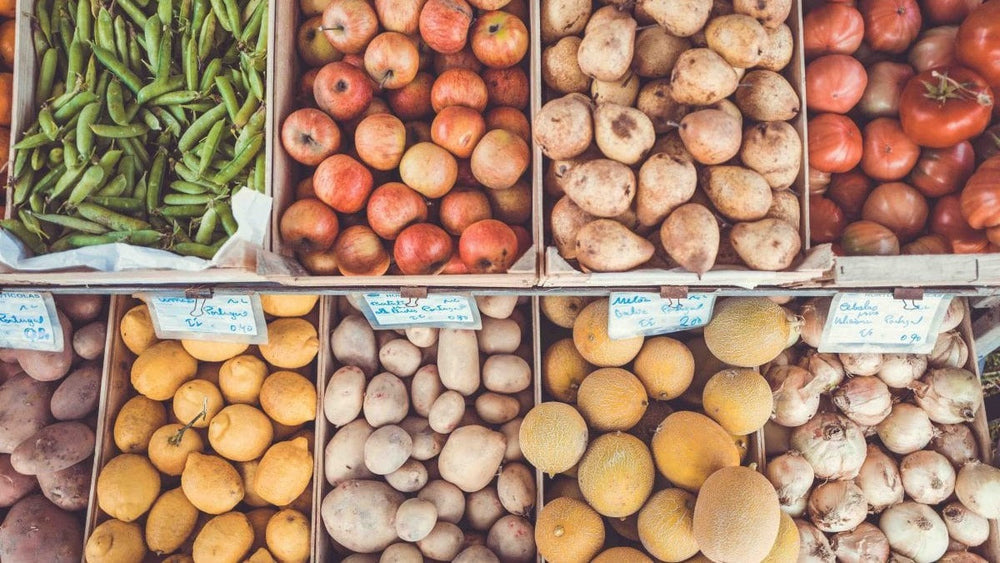
Organic quality fruit
Important supporters of digestion are fibers/dietary fibers. These are found primarily in vegetables. In addition to a high fiber content, they also provide various vitamins and, in combination with various types of fruit, act as real fitness boosters. In general: all varieties that have to be cooked for humans should also be cooked for dogs. Vegetables that we consume raw ourselves may also be eaten raw by the dog. The more finely fruit and vegetables are chopped, the better the various vital substances are made available. It is recommended to use regional and seasonal varieties in organic quality, as this keeps the ecological footprint small and puts less strain on the dog's organism.
Since avocado, onions, garlic, and leeks are sometimes poisonous (depending on the dosage and plant part), they should not be fed. Under no circumstances should grapes be provided!
Minerals
ALL-IN VELUXE
Since not all essential nutrients are supplied in sufficient quantities by natural ingredients, it is necessary to supplement with a mineral powder. For this purpose, we have developed "ALL-IN VELUXE". The amount to be administered depends on the raw materials to which it is added. We regularly provide new recipes for this and offer individual ration calculations. This ensures our vegan four-legged friend gets everything they need to romp healthily through life.
We wish them a good appetite
Your VEGDOG Team