
OVERWEIGHT DOGS – HOW TO HELP THEM LOSE WEIGHT!
 Author: Alena
 Proofreader: Veronika
Educating the pet owner is particularly important, as being overweight is not just a cosmetic problem but can have negative consequences for the dog's entire organism.
And now, there is also purely plant-based food for dogs on the market. Not only as producers of VEGDOG, who have developed the food together with specialist veterinarians, but also as dog owners who feed it with a clear conscience, we are often insulted and confronted with various arguments against a vegan diet for our four-legged friends. How do you respond to this, and how do you refute the many baseless prejudices? We have taken up the most common points of criticism and examined them in more detail.
Definition of overweight
A dog is considered overweight when it exceeds its ideal weight by 10%, and obese when its ideal weight is exceeded by more than 20%. The medical term for this excess body fat is adiposity. The reason for a dog being overweight is always an excessive energy intake, meaning the animal consumes more energy than it can burn in total (this is therefore also referred to as a positive energy balance).
Reasons for dogs being overweight
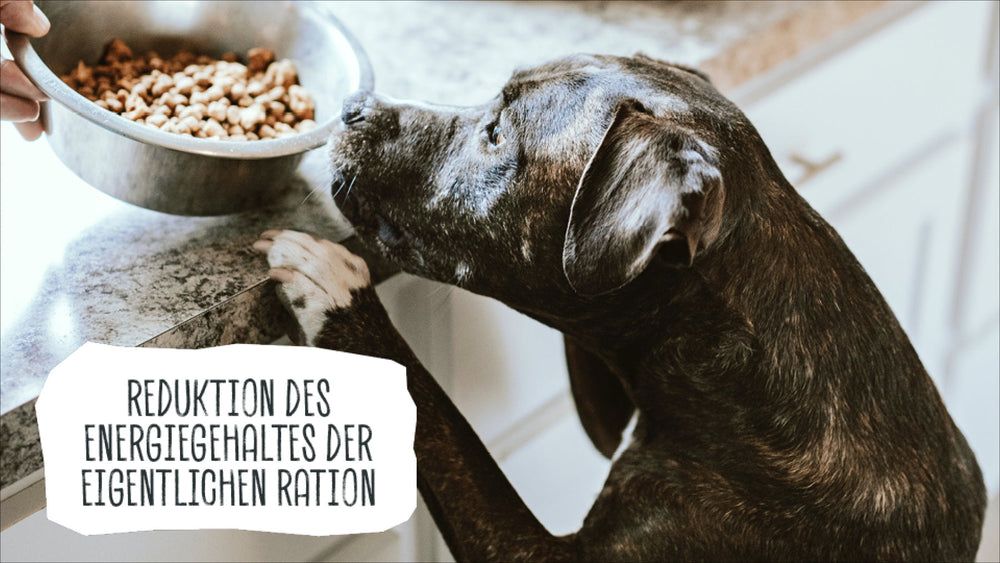
The reasons for a dog being overweight are manifold. They are often attributable to incorrect feeding habits on the part of the owner, who – usually due to a lack of knowledge – misjudges their animal's energy requirements. These can vary significantly and depend, for example, on age and physical activity level. When your animal gets older, its energy requirements drop by about 25%, and after a neutering procedure, a reduction in food and treat (!) portions is usually required.
Genetics, certain diseases such as hypothyroidism, or conditions requiring glucocorticoid therapy can also influence a dog's weight. Another cause is the often prevalent lack of exercise. Short walks on foot burn far less energy than many dog owners might wish.
Consequences of being overweight
It is important to remember that the storage of body fat is not just unsightly, but also affects the body like a chronic inflammation. This is because adipose tissue releases inflammatory mediators such as acute-phase proteins, for example.
The consequences of being overweight or having adiposity in dogs are manifold: firstly, the dogs become sluggish, less active, and quieter than their actual character would normally dictate. Secondly, the cardiovascular system is put under strain, it can lead to joint problems as well as diabetes, the risk of skin diseases increases, and the immune system can suffer. Last but not least, it should always be borne in mind that the life expectancy of overweight animals is reduced by about 20%.
When is my dog too fat?
Since the number of overweight animals has risen sharply, the eyes of many owners have effectively "adapted" to this condition, so that it is perceived as "normal." To ensure an objective impression, veterinary medicine uses the so-called "Body Condition Score" (BCS). The nutritional state is determined on a scale of 1-9, where 1-3 is classified as too thin, 4-5 as normal, and 7-9 as overweight.
With an optimal nutritional state, a waist is recognizable when viewed from above, and a light layer of fat can be felt over the ribs with the flat of the hand. Viewed from the side, the abdominal line should rise slightly.
Most dogs have reached their ideal weight at the age of about one year. You should make a note of this to use as a reference later.
To receive further information on reducing excess weight, read our article
Part 2 – How can I help my dog lose weight?
Your VEGDOG Team