

Dog Body Language: Correctly Interpreting Tail Wagging, Yawning, and Growling
Your dog communicates with their whole body. Discover how to correctly interpret their signals and avoid misunderstandings.
 Author: Selina
Understanding Dog Language: These Signs Show a Relaxed Dog
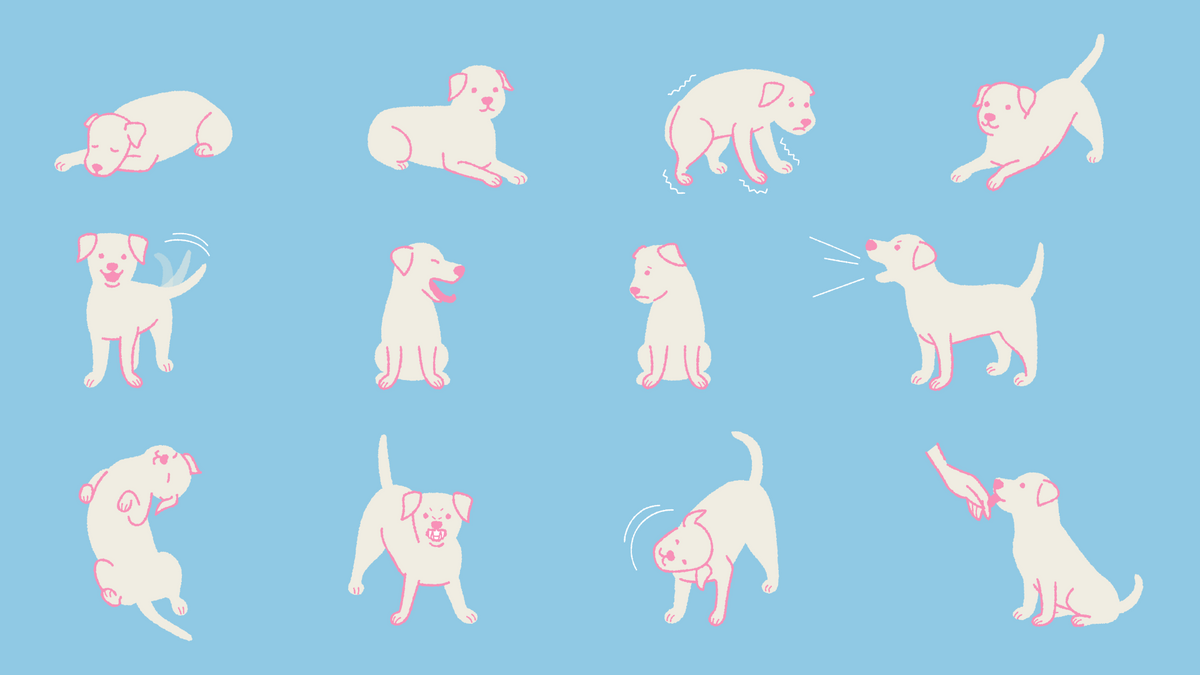
A relaxed dog usually moves loosely and fluidly. Its facial features appear soft, its muscles are relaxed, and its gaze is neither fixed nor tense. A loosely open mouth can also indicate well-being.
How clearly these features are visible depends on several factors, including the dog's build. For example, it can be harder to see the position of the ears on a dog with floppy ears than on one with upright ears.
A Dog Wagging Its Tail: Why Tail Height and Movement Matter
Many people automatically associate a wagging tail with a happy dog. In fact, it can express a wide range of emotions. The tail's height, speed, and type of movement are key.
- Wide, loose tail wagging: If your dog moves its tail in wide arcs and swings its hindquarters along with it, this often indicates a friendly, positive mood.
- High-held tail with short, quick movements: This posture can indicate strong excitement or tension, especially if the rest of the body appears stiff.
- Low-held tail with small movements: This type of tail wagging can express restraint or uncertainty.
- Slow, rather stiff wagging: This may indicate that your dog is alert or waiting.
The rest of the body posture also plays a role. For example, if your dog wags its tail while backing away, it is best to give it some space.
Stress Signals in Dogs: From Yawning to Freezing
Not every dog barks or growls when it feels uncomfortable. Many dogs first show less noticeable behaviors. You should therefore be aware of the following stress signals:
- Frequent blinking or yawning: This can indicate tension, especially in unfamiliar or uncomfortable situations.
- Licking its muzzle: This can be an expression of uncertainty and may also serve as a calming signal.
- Panting without heat or physical exertion: This can be a stress response. If your dog pants unusually heavily or persistently, you should also have a veterinarian rule out any underlying health issues.
- Pinned-back ears and a tucked tail: These can indicate fear or discomfort, especially if your dog also crouches or backs away.
- Lifting a front paw: This can signal uncertainty or hesitation, for example during an unfamiliar encounter.
- Sudden freezing: This is a serious warning signal. Your dog stands motionless and tenses its body. In this case, you should stop approaching or touching it.
However, none of these behaviors is automatically a sign of stress. After all, a dog can also yawn because it is tired or lick its muzzle after eating. Therefore, pay attention to the situation in which the signals occur and how your dog behaves overall. Multiple signs occurring at the same time can be particularly indicative of stress.
Calming Signals: Turning Away, Avoiding Eye Contact, and Approaching in an Arc
Some body signals can help defuse tense encounters. Such behaviors are often referred to as calming signals. They can convey to the other dog that the dog is not looking for a confrontation. These include, for example, averting its gaze, turning its head, or approaching in an arc rather than directly. Some of the stress signals mentioned earlier can also occur in such situations.
Imagine your dog encounters another dog while you are out for a walk. Instead of walking directly toward it, your dog slowly approaches in an arc and avoids prolonged eye contact. In doing so, it may be trying to make the encounter less confrontational. You can learn more about what to look for when dogs interact with their own kind in our guide to relaxed dog encounters.
However, calming signals do not always have to convey a conscious message to the other dog. Some behaviors may simply be an expression of inner tension.
Threat Signals in Dogs: From Avoiding to Snapping
If a dog feels threatened and cannot avoid the situation, its behavior may become increasingly pronounced. Several stages of escalation can be observed:
- Initial warning signs: Your dog turns its head away, yawns, or licks its muzzle. This can indicate discomfort.
- Withdrawal and seeking distance: It backs away, turns away, or seeks shelter behind you to gain distance.
- Freezing: Your dog suddenly stops, its muscles tense, and its gaze becomes fixed. This is a serious warning signal.
- Clear threat signals: It fixes its gaze on the other dog, shows its teeth, or growls to demand more distance.
- Further escalation: If it continues to feel threatened, it may snap at the air or bite.
Important: This sequence is not a fixed rule. Dogs may skip individual stages or show signals in a different order. Therefore, take early warning signs seriously and create sufficient distance.
Why You Should Not Punish Your Dog for Growling:
Growling is an important part of dog communication. It often serves as a warning, with which your dog is demanding more distance. It does not therefore automatically mean that your dog is generally aggressive.
Punishing your dog for growling can be problematic. It could teach your dog to suppress this warning signal without its tension disappearing. In the worst-case scenario, it may snap in the future without warning clearly beforehand.
Therefore, take threat signals seriously and increase the distance from the trigger. If your dog regularly shows strong threatening behavior, professional behavioral advice can help identify the causes and deal with such situations safely.
Dog Body Language in Everyday Life: Four Typical Situations
Understanding dog language can be particularly helpful in moments when misunderstandings are likely to occur. The following examples show how you can recognize body signals and react appropriately.
1. Your Dog Encounters a Child
A child wants to hug your dog. Your dog turns its head away, crouches, and tries to seek shelter behind you. Even if it remains calm, this does not mean it is enjoying the hug.
What you can do: Calmly end the contact and give your dog the opportunity to move away. Children should not crowd a dog and should never be left alone with one.
2. Your Dog Is at the Food Bowl
You approach your dog while it is eating. Suddenly, it stops, tenses its body, and fixes its gaze on you. It may even start to growl. This can be an indication that it wants to defend its food against a perceived threat.
What you can do: Let your dog eat undisturbed. Do not reach into the bowl or try to test its reaction. Keep children away in particular. If it regularly shows this behavior, you should seek professional help.
3. Your Dog Is at the Vet
In the waiting room, your dog is panting even though it is not warm. Its ears are pressed close to its head, and it repeatedly lifts a front paw. This combination can indicate stress or uncertainty.
What you can do: Talk to the practice team about these signs. If the examination allows, short breaks or more distance from other animals can help. If necessary, you can also discuss how to make future visits more pleasant.
4. Your Dog Is Lying on the Sofa
Your dog is resting next to you on the sofa. When you pet it, it turns its head away and slides a little away from you. This could mean that it would prefer to be left alone.
What you can do: Stop petting it and let it decide whether it wants to seek closeness again. If it becomes stiff or growls, you should give it space instead of physically pushing it off the sofa.
How You Can Learn to Better Read Your Dog's Body Language
The more often you observe your dog in different situations, the more familiar you will become with its ways of expressing itself. These three small exercises can help you:
- Compare greetings: Observe how your dog reacts to familiar people and how it behaves when an unfamiliar visitor arrives. It may wag its tail in both situations, but show clear differences in its body posture.
- Take play breaks: Briefly interrupt a joint play session and observe how your dog reacts. Does it invite you to play again, or would it rather occupy itself with something else?
- Record observations: Occasionally make a note of the situations in which your dog shows certain signals. Over time, you will be able to better recognize what triggers it and what helps it.
You can also use this knowledge during joint training. Pay attention to whether your dog is participating attentively and calmly or needs a break. If it shows desired behavior, you can reward it with praise or a small treat.
Our tip: If your dog has food intolerances, it is also worth checking the ingredients of training treats. The plant-based VEGDOG Snacks, such as Mini Pures, Beevys and Levervurst, are a suitable option here, as they are free from common allergens.
Mini Quiz: What Is This Dog Saying?
Now it is your turn! Imagine the following situation:
Two dogs are playing together. Suddenly, one of them lowers its front body, stretches out its front legs, and holds its hindquarters up. Then it hops to the side with loose movements.
What could its body language mean?
- A: It feels threatened and wants distance.
- B: It is inviting the other dog to play.
- C: It is showing a clear threat signal.
The described posture is often referred to as a play bow. It can be a friendly invitation to play. The loose movements and subsequent hopping around are particularly indicative of this.
The correct answer is B!
Conclusion: Understanding Your Dog Means Taking Its Signals Seriously
Whether playing, eating, or encountering other people, your dog shows you in many ways how it feels. If you know its body language better, you can react more appropriately to its needs and improve your communication together.
For your next joint training sessions, you can find suitable plant-based rewards at VEGDOG: Our Snacks.