

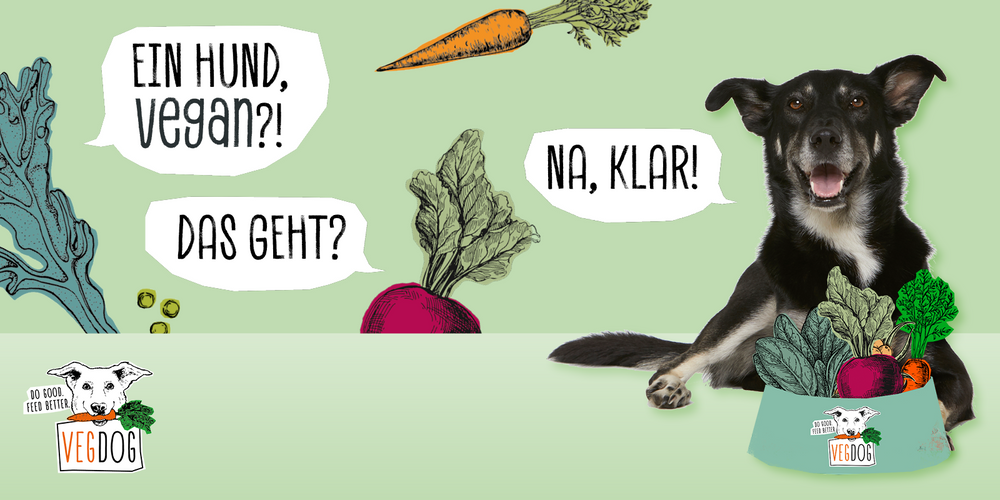
Vegan dog nutrition: Pros & Cons – VEGDOG
 Author: Veronika
 Proofreader: Carla
THE MOST COMMON ARGUMENTS AGAINST VEGAN DOG NUTRITION AND HOW TO REFUTE THEM
Even for humans, a vegan diet is a controversially discussed topic that often meets with a lack of understanding. Arguments against a purely plant-based diet are quick to hail down. Before you know it, you are being enlightened about the numerous disadvantages, even though you have looked into the topic much more intensively yourself and know the numerous advantages. The same thing can happen to you if you feed your beloved four-legged friend a vegan diet. Not only as producers of VEGDOG, who developed vegan dog food with specialist veterinarians, but also as dog owners who feed it with a clear conscience, we are often insulted and confronted with various arguments against vegan dog nutrition. How do you react to this and how do you refute the many unfounded prejudices? We have taken up the most common points of criticism and examined them more closely.
PREJUDICE 1: FEEDING DOGS A VEGAN DIET IS NOT SPECIES-APPROPRIATE
We often ask ourselves, what kind of statement does this refer to? To the wolf? Or to the "wild dog"? Both live in the wild without contact with humans, wearing neither collar nor harness. They relieve themselves whenever they wish and do not visit a veterinary practice to cure illnesses and thus extend their lives. Food is certainly not provided daily, and riding in a car is a completely unknown means of transport for them. They do not go to exhibitions to present their beauty. They choose their own partners.
Placing dogs on the same level as their ancestors is, in our view, a flawed comparison, because the lifestyle of our four-legged friends no longer has anything in common with that of the wolf. According to the latest findings, the dog joined humans approximately 100,000 years ago. During this time, it has become a domestic animal and has little left in common with its wild ancestor. The same applies to us humans. Although we descend from apes, our way of life and diet have changed enormously. And yet, we do not doubt that the life we lead today is species-appropriate. We have simply evolved.
PREJUDICE 2: THE BEST WAY TO FEED A DOG A HEALTHY DIET IS BY BARFING, NOT BY VEGAN DOG NUTRITION
For many years now, BARF (biologically appropriate raw food) has been a more than popular feeding method. This approach often relies on the animal's ancestry from the wolf, whose main dietary component is considered to be raw meat. It is frequently overlooked that wolves devour their entire prey, including skin and fur. Internal organs, bones, and cartilage are also consumed, providing many nutrients that are not present in muscle meat alone.
Furthermore, wolves have a much shorter life expectancy than our dogs. To cover the complete requirement for minerals, trace elements, and vitamins, all components must be fed in a specific composition. The supplementation of a mineral powder, combined with nutritional advice from a competent veterinarian, is usually essential to ensure that your four-legged friend is being fed according to their needs.
Unfortunately, many owners are still unaware of this, as a study by Natalie Dillitzer has already proven. This study revealed that a large proportion—60%—of the BARF rations analyzed suffered from significant deficiencies. It is not the type of feeding, but the nutritionally complete composition that determines the quality of a ration. A meat-based diet can therefore also lead to nutritional imbalances and deficiencies if it has not been calculated in a balanced way.
Especially in the case of food intolerances, vegan dog food could help your four-legged friend. Many dog owners are unaware that animal proteins are among the main allergens for dogs. For dogs with severe food allergies, vegan dog food could therefore be a healthy alternative. VEGDOG is nutritionally complete, 100% plant-based, and gluten-free.
PREJUDICE 3: THE CONSUMPTION OF PLANT-BASED, CARBOHYDRATE-RICH FOOD IS UNHEALTHY AND NOT INTENDED FOR DOGS
Over the course of domestication, the dog has adapted to humans not only in terms of behavior. Its digestion also inevitably had to adjust to the available food supply. Since meat was a luxury item, it only very rarely ended up in the food bowl as leftovers.
Since the study by an (independent!) Swedish research team was published in 2013, we have known: the dog has genetically evolved and can digest carbohydrates in much larger quantities than the wolf, and even more efficiently than horses. This is due to a better enzyme composition. However, we would also like to point out that not every plant-based food ingredient is composed exclusively of carbohydrates.
Peas, lentils, lupins, and many other plant-based protein sources contained in vegan dog food primarily provide our four-legged friends with important proteins in an optimal amino acid composition, so that meat is not necessary. As long as your four-legged friend's protein requirements are met with a vegan diet, it is anything but unhealthy.
PREJUDICE 4: A DOG'S INTESTINE IS FAR TOO SHORT TO DIGEST PLANT-BASED FOOD
The intestine of our domestic dogs is indeed shorter than that of various animals geared towards the primary utilization of plant-based dietary components. However, it must be clearly emphasized that plant-based components in vegan dog food are not provided in their raw state.
As with conventional, meat-based food, the raw materials are broken down through the manufacturing process and can thus be utilized by the dog to a sufficient extent. Naturally, we do not use raw lentils, peas, or lupin beans, for example, but rather highly processed, extruded lentil, pea, or lupin protein, which the dog can utilize very well even with its shorter intestine. Anatomically, therefore, there is nothing standing in the way of a vegan dog food.
MYTH 5: A DOG CANNOT POSSIBLY GET ALL THE NUTRIENTS IT NEEDS FROM A PURELY VEGAN DIET
It is not the meat itself that the dog needs, but the nutrients contained within it. Almost all substances found in animal products can be replaced by plant-based alternatives. It is frequently argued that dogs need animal protein in order to survive.
Extensive analyses have revealed that there are plant-based protein sources with an amino acid profile similar to that of meat. As the necessity of taurine and carnitine intake is currently being debated in the scientific community, these substances should be supplemented in vegan dog diets. The same applies to the amino acid methionine.
In cats, for example, supplementing taurine is common practice even with a meat-based diet, yet this is never called into question by anyone. In fact, many deficiency symptoms occur in dogs and cats fed a meat-based diet, as such diets are not automatically supplemented with the appropriate nutrients.
PREJUDICE 6: YOU WOULD BE FORCING YOUR OWN LIFESTYLE ON THE DOG: FEEDING A DOG A VEGAN DIET IS ANIMAL CRUELTY
If a dog cannot hunt for its own food, it must in any case eat what is put in its bowl. Every owner has different views on which form of food is acceptable for their four-legged friend. Thus, every dog is more or less forced to eat the food that its owner deems appropriate. In our view, the primary responsibility is to provide the dog with all the necessary minerals, trace elements, and vitamins it needs to maintain its health.
As already mentioned, studies have shown that many home-prepared, meat-based rations suffer from a deficiency and/or an oversupply of various substances. Of course, no one wants to deliberately harm their animal. Certainly, many BARF portions are balanced and enjoyed. However, we believe that it borders on cruelty not to feed a dog in a way that meets its nutritional needs rather than providing it with everything it requires, albeit on a plant-based basis with vegan dog food.
PREJUDICE 7: VEGANISM IS JUST A TREND: SELLING VEGAN DOG FOOD IS ONLY A WAY TO RIP PEOPLE OFF
Perhaps some people are indeed following a trend by feeding themselves and their dogs a vegan diet. However, the majority are protesting against the unacceptable conditions that pigs and other animals have to endure in factory farming. Furthermore, there are concerns that feeding dogs meat could cause them harm. Animal protein has long been suspected of causing various diseases.
We repeatedly receive testimonials in which dog owners confirm that their four-legged friends are doing much better after switching to a vegan diet with VEGDOG following years of suffering. Since not everyone has the time to cook for their pet, it is a relief to be able to fall back on high-quality prepared food.
We at VEGDOG can, of course, only speak about our own motives for producing vegan complete dog food. We ourselves were missing a product on the market that met our requirements. We rejected offers to produce vegetarian dog food as well, based on ethical considerations, even though that would likely have earned us a far better profit.
TWO OF MANY FATES
Amelie the sheep was very sick at the beginning. She suffered from liver damage, one leg was dislocated, and she was severely underweight. Emergency slaughter was imminent. We promptly took over the veterinary costs so that, thanks to her osteopathic treatment, Amelie was able to put weight on her leg again. This allowed Amelie to fully enjoy the evening of her life until she sadly passed away in January 2022.
Cäsar was also a particularly moving case. The vets wanted to put him down due to a joint condition and refused to treat him. At the time, the little buck was only eight months old. But we didn't want to give up on Cäsar.
We decided to treat him like one of our beloved VEGDOGs, i.e., like a family member – regardless of the cost. So, we brought him to a specialized clinic for dogs, where he received the treatment he deserved. You might be surprised that he was treated in a clinic for dogs. Unfortunately, it is the case that so-called farm animals are usually not fully treated when they are sick. Therefore, the veterinary medical conditions for such a procedure are lacking in this sector. It was an expensive decision, but anything else was out of the question for us.
Cäsar’s fate reminds us that every life, whether a so-called farm animal or a pet, is precious and deserves to be saved.
Our small flock of sheep is just the beginning! While we already save many animal lives through the sale of our products, we want to do even more – for example, with further rescue missions. Every living creature has the right to life, peace, and joy. That is why we want to keep growing the VEGDOG family and provide a good life for as many animals as possible.
Stay tuned!
FAQ
CAN DOGS BE FED A COMPLETELY PLANT-BASED DIET?
Yes, dogs can be fed a purely plant-based diet. However, it is important to meet their requirements for proteins, minerals, trace elements, and vitamins. Furthermore, the amino acids taurine, carnitine, and methionine should not be missing from a vegan canine diet.
IS IT REASONABLE TO FEED DOGS A VEGAN DIET?
Especially in cases of food intolerance, a vegan diet can be a healthy alternative for dogs. Animal proteins are, in fact, among the primary allergens for dogs.
HOW MANY PEOPLE FEED THEIR DOG A VEGAN DIET?
As part of a study, 2,536 people were surveyed about how they feed their dogs. 13% stated that they feed their dog a vegan diet. The study also concluded that a vegan diet for dogs is the healthiest way to feed them.