


Insights from a veterinarian on the topic of vegan dog nutrition
 Author: Carla
 Proofreader: Veronika
This is, quite simply, about the question: "How should I feed my dog?". For several years now, I have noticed that this question not only divides opinions but also leads to heated arguments. As a veterinarian specializing in small animal nutritional counseling, terms like "grain-eaters" and "Taliban barfers" are long familiar to me. Since I have been wholeheartedly committed to the development of VEGDOG, one thing has become increasingly clear: dog owners are their own worst enemies. Tolerance? Non-existent. For many, their dog has become the center of their life (or perhaps the main burden of their life?!). Their own pet is flawless. If there is trouble, others are to blame. Friendships fall apart over differing views on training (the owners' friendships, that is; the dogs are usually quite unconcerned). And when it comes to bullying, it often leaves me speechless to see how far people will go to tear someone down for their way of thinking. This happens to us at VEGDOG, too. We are frequently accused of being animal abusers, that vegan dog food is not species-appropriate, and that we should be locked away immediately. I admit it. I haven't grown a thick enough skin yet. I love my two dogs, too, and I only want the best for them! They never have to stay alone, are allowed to romp around in forests and fields with playmates more than regularly, and get mental stimulation. They get lots of cuddles (Yes, I admit it—they even sleep in my bed!) and receive immediate veterinary care when they are sick. And—I have decided to feed them a vegan diet. Reaching this decision was a long process for me as well. After feeding high-quality dry food and the subsequent development of allergies, it was only natural for me to prefer cooking for my dogs and later switching to BARF (biologically appropriate raw food). Who hasn't heard of dog forums? Anyone who asks a question more or less related to the diet of our pets is sooner or later (usually sooner) advised to feed them BARF. I ended up there, too. I, too, didn't understand how anyone could choose a different form of feeding.
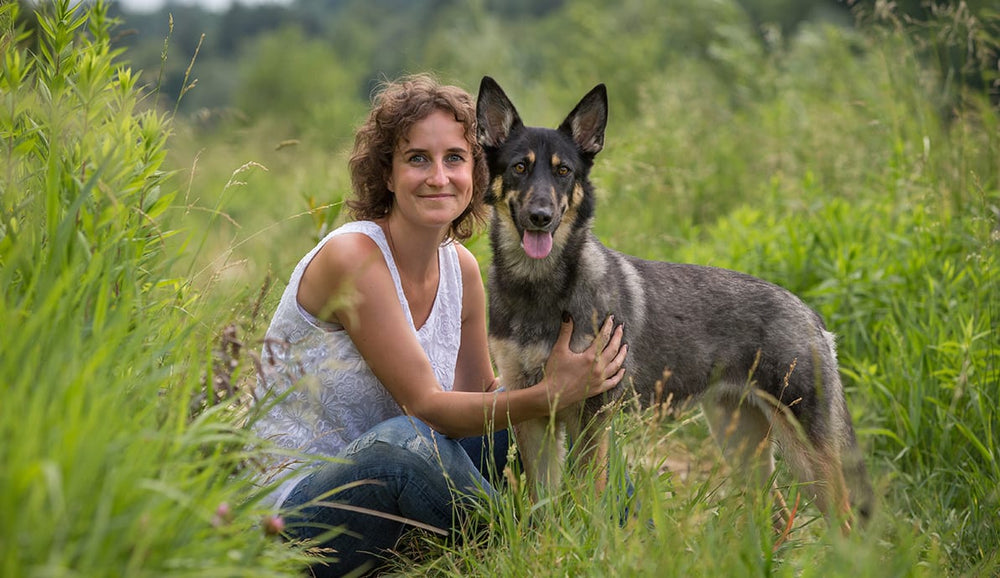
[/vc_column_text][vc_single_image image=”2399″ img_size=”large” alignment=”center”][vc_column_text]Veterinarian Lisa and her Romy[/vc_column_text][vc_column_text]Then I became a vegan myself. I grappled with many thoughts regarding animal suffering. Through my studies, I naturally had very real images in front of me: the pigs in their farrowing crates, the cows whose calves were taken from them immediately after birth, and, of course, the slaughterhouse. By the time I had to complete a three-week internship there, I would have become a vegetarian. And not just because of the mass killing process, which is carried out here like an assembly line. The hygienic conditions were more than gruesome. As a result, it became increasingly strange for me to put a portion of meat in my dogs' bowls every day. Although I had identified one of the few shops that sells organic meat to dog owners, one sentence kept running through my head: "There is no such thing as meat from happy animals. Only from dead ones." Through my professional work, I had quickly learned that a vegan diet for dogs, while not standard, is certainly possible. I decided to cook vegan meals for my dogs. Only for a few days. I wanted to test if they would eat it at all, how their digestion would handle it, and, of course, the tolerance. Under no circumstances did I want to force something on my furry friends—whom I love dearly, as mentioned—that wasn't good for them. I got to the stove and quickly realized that the contents of the bowl were very similar to those containing meat. The meat had simply been replaced by plant-based ingredients that provided protein with the corresponding amino acid profile. My dogs liked their new food immediately. They tolerated it well; their digestion actually worked better than before. Their coats remained shiny, they still didn't smell unpleasant, and their teeth were no worse off. For me, it was a small step with a big impact. My dogs were still happy about their meals, they had no health restrictions as a result, but they were saving the lives of other animals.[/vc_column_text][vc_column_text]It could be so simple. If it weren't for the people who tell you every day that you are doing something evil. That you don't care about what your own dog needs and that you are torturing him with this diet. I find that more than sad, as I consider myself very tolerant. I have never asked someone who feeds their dog BARF why they don't keep a couple of rabbits and let the dog hunt them and eat them whole if they base their arguments on the wolf. I have never pointed out that while there is constant talk of natural nutrition, a dog could never catch and kill a pig or even a cow. I have also never clarified that wolves in the wild only live to be about 5 years old on average (personally, I wish for a much higher life expectancy for my dogs), let alone asked whether a wolf would be allowed to relieve itself only every few hours because it is let out according to human schedules (and kept on a collar and leash). The big discussions about "species-appropriate" are more than ignorant. And frankly, it borders on arrogance when people claim they can actually keep a living creature in a truly species-appropriate way. The bird in the cage, the horse in the stable, or the rabbit in the hutch—none of them have a chance to lead a life as they would in the wild. Do we really have to argue about what ends up in our dogs' bowls?! No person in the world can offer an animal a truly species-appropriate life, not even a pet. But they can try to enable them to have a happy and healthy life. That is exactly what we want to achieve with VEGDOG.[/vc_column_text][vc_column_text]The fact is: the dog is not a wolf. As a rule, it is fed differently, even when on a BARF diet. We can no longer guarantee a natural, "wolf-like" lifestyle for the dog. It has lived closely by our side for about 100,000 years and has adapted accordingly. By comparison, cats have only been domesticated for about 9,000 years. We all love our pets and want the best for them. What that is, we have to decide individually and judge for ourselves based on the health and vitality of our dogs. In this regard, however, I would like to see more tolerance. I don't want to have to constantly justify the fact that my empathy extends not just to a few, selected creatures, but to all of them. I don't want my dogs to be pitied when they lead a great life, are loved, and are also the center of my life. I hope for a more open and fair interaction among all dog owners. In times of breed-specific legislation, mandatory leashes, and muzzle requirements, we already have enough to endure within our community. Yours, Lisa from the VEGDOG team