
VEGDOG'S ONE POT MEETS ALL NUTRITIONAL NEEDS
 Author: Alena
 Proofreader: Carla
Moreover, we don't have to rely on the claims of various feed manufacturers regarding the composition of their products and can see for ourselves where the nutritional requirements are being met.
However, there is one disadvantage to wielding the wooden spoon yourself… It takes time. Simply emptying the contents of a can or bag into the bowl won't cut it. Things have to be soaked and chopped, cooked and pureed. Nowadays, it is sometimes difficult to free up the necessary time.
For this reason, we have come up with a recipe today where almost all the ingredients go into one pot –VEGDOG’S ONE POT:)! All you have to do is weigh everything out. A large portion is then cooked together and pureed if necessary.
Necessary ingredients and daily ration in grams:
| INGREDIENTS | 5 KG | 15 kg | 25 KG |
|---|---|---|---|
Peas | 100 g | 200 g | 300 g |
Vegetables | 50 g | 100 g | 180 g |
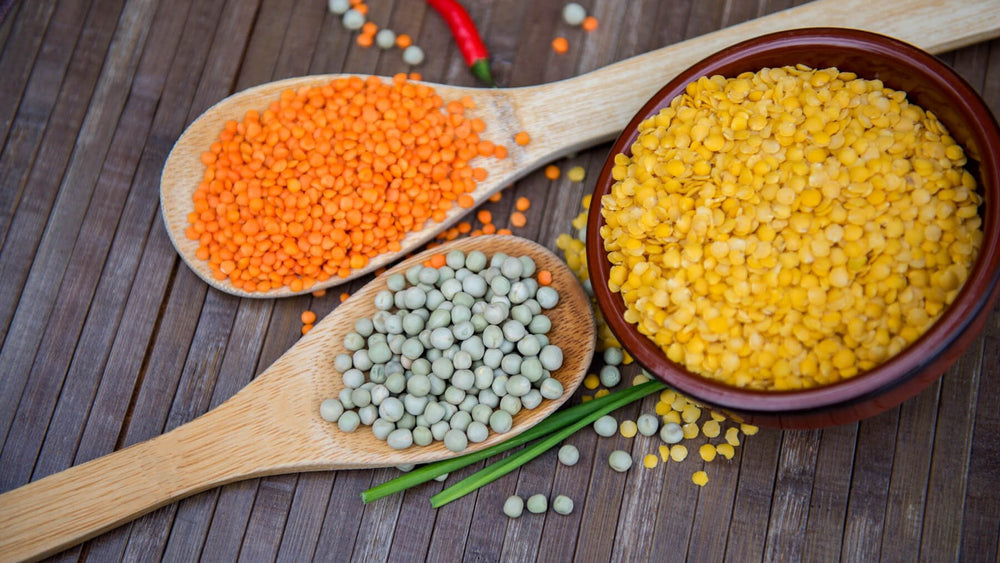
Lentils (pre-cooked) - if raw, reduce the weight accordingly | 90 g | 200 g | 260 g |
Couscous (precooked) - if raw, then reduce the weight | 40 g | 100 g | 210 g |
Oil (algae oil/hemp oil/flaxseed oil, alternating) | 5 g | 15 g | 0.88 oz |
Desiccated coconut | 5 g | 0.35 oz | 15 g |
Nuts | 5 g | 15 g | 0.88 oz |
see pkg. | see pkg | see pkg | |
Herbs | 0.5 g | 0.8 g | 1 g |
QUANTITY CALCULATION EXAMPLE:
The calculation of the quantity is based on the different weight classes. For example, a small dog requires more in proportion to its body weight than a large dog. You should always use the highest weight class we have specified as your guide. If your dog, for example, weighs 6 kg, you use the weight class for 10 kg as your guide. If your dog, for example, weighs 32 kg, you use the weight class for 25 kg as your guide, as that is the highest weight class we provide.
Here is a calculation example for you if your dog weighs, for example, 32 kg: The highest specified weight class is 25 kg, so that is your required reference quantity. A 25 kg dog requires 100 g of chickpeas daily. Therefore, 1 kg of dog in the 25 kg weight class requires —> 100 g/25 kg = 4 g of chickpeas per kg of body weight. Then a 32 kg dog requires 4 g x 32 = 128 g of chickpeas/day. You perform this calculation for all ingredients. I hope we were able to help you.
Preparation
Cook vegetables
Weigh the peas, the vegetables, the lentils, and the couscous. Use our specifications for the individual weight classes as a guide for this.
Peas from the freezer section are particularly suitable. For the vegetables, it is best to look for regional and seasonal produce in organic quality (though this is, of course, not a must).
Place the mentioned ingredients in a pot, cover them with water, and cook them until they are really soft. We used about an hour for this, and in the meantime prepared the remaining ingredients and worked on new products for you from our home office 🙂
ATTENTION – DO NOT ADD THE FOLLOWING TO THE POT:
Keep in mind that bulbous plants, eggplants, tomatoes, and bell peppers are not suitable for dogs. Instead, it is recommended to add, for example: zucchini, broccoli, various types of cabbage, carrots, fennel, and celery.
We used the dry ingredients to conjure up a topping that was placed on our "pot" as a final layer. For this, wemixed the oil with the powder and the herbs(you may need to add a little water for a creamy consistency) and added thechopped nuts.
Toxic herbs
The question often arises as to which herbs you can safely use for your furry friends. Generally speaking, you can use almost all of them! And the great thing is that every herb has a different, positive effect on the body. There are only a few herbs and spices that are generally not recommended. These include garlic granules, onion powder, pepper, and nutmeg.
Some ingredients only have a negative effect in the presence of certain medical conditions.
For example, rosemary must not be fed to dogs with epilepsy, as it can trigger seizures.
In general, pregnant bitches should be considered a high-risk group when it comes to herbs. Due to their sometimes labor-inducing effects, they should not be given sage, parsley, coriander, or dill.
We recommend that you inform yourself well in advance or contact us.
Healthy herbs
Some herbs can be safely offered to every dog.
For example, basil has anti-inflammatory and digestive properties.
Watercress stimulates the appetite and contains important minerals and trace elements, and nettle has long been known as a good remedy for detoxification.
Please remember that you first need to find out whether your four-legged friends like the new ingredients. So, start by adding small amounts. Dried herbs are often accepted better than fresh ones.
Nuts
Once you have decided on the herb that is right for you, you need to decide on the types of nuts you want to use in this recipe.
Here, too, you have a large selection to choose from. However, a word of advice beforehand: nuts (especially peanuts) can potentially be allergenic, so test carefully (do not start with large quantities or different varieties at once).
As a rule, nuts contain high-quality fatty acids and various minerals and trace elements. You can choose from hazelnuts, walnuts, Brazil nuts, cashews, and pistachios, among others. You are also welcome to share your chestnuts with your loved ones. These are particularly well-tolerated.
Toxic nuts
Be sure to avoid feeding macadamia nuts, bitter almonds (sweet almonds are allowed), and black walnuts, as there is a risk of poisoning!
Once you have selected your ingredients and mixed your topping, there isn't much left to do. It is recommended to purée the ingredients in the pot to improve digestibility. Add the mineral mix once everything has cooled down so as not to damage the sensitive vitamins.
We didn't need much more time to prepare this meal than it takes to open a can. How are you doing? We look forward to hearing your reports!
Fundamental and important points you should keep in mind when cooking for your dog:
1. Processing vegetables
You can be very flexible and creative when choosing vegetable varieties. We recommend using regional and seasonal products. As a general rule for preparing vegetables: whatever you can eat raw as a human, your dog can also receive raw. Everything that you have to cook for yourself should also be cooked for your dog.
Thus, you may feed raw, for example: carrots, cucumber, lettuce, zucchini, kohlrabi, pumpkin
Should be cooked: spinach (only in small amounts!), broccoli, cauliflower, Brussels sprouts
You can puree, grate, or chop the raw vegetables into coarse pieces. The finer they are processed, the more available the vitamins are for digestion. However, all recipes are generally nutritionally complete even if you feed the vegetables in large chunks. This creates more fullness in the stomach. This (sometimes visually psychological) effect is especially positive for dogs that are constantly hungry. In addition, the important intestinal bacteria are nourished by the increased fiber content.
Since cabbage can cause gas even when cooked, you should start with small portions and increase them meal by meal.
Spinach contains oxalic acid. Small amounts are allowed occasionally for healthy, adult dogs. Puppies, young dogs, and dogs with health issues should not eat spinach.
Conventional vegetables should always be washed thoroughly before processing – especially if they are fed with the skin on. Alternatively, it is of course advisable to use organic quality products.
You can alternate the different types of vegetables as you like.
We recommend taking your dog's preferences into account 🙂
Attention: You should NOT feed onions, garlic, eggplant, peppers, and tomatoes.
2. Add fruit cooked or raw
Fruit can also be combined and alternated – depending on what your dog tolerates. Suitable options include, for example, apples, oranges, bananas, raspberries, strawberries, melons. You don't need to worry about the fruit sugar contained. This does not lead to obesity when feeding fresh fruit. For obese animals, however, the amounts of banana should be kept low and dried fruit should be avoided if possible. This has a higher calorie content and can also lead to gas and diarrhea. Fruit seeds/pits should be removed as they contain hydrogen cyanide. Please wash the fruit thoroughly before feeding. Here, too, you can let your imagination run wild with the preparation – from chopped to grated or as a smoothie – whatever is fun is allowed. Also read our articles "Smoothie for Dogs" and "Summer Time is Ice Cream Time"