
NEW ADDITION TO THE FAMILY! ADOPT OR BUY?
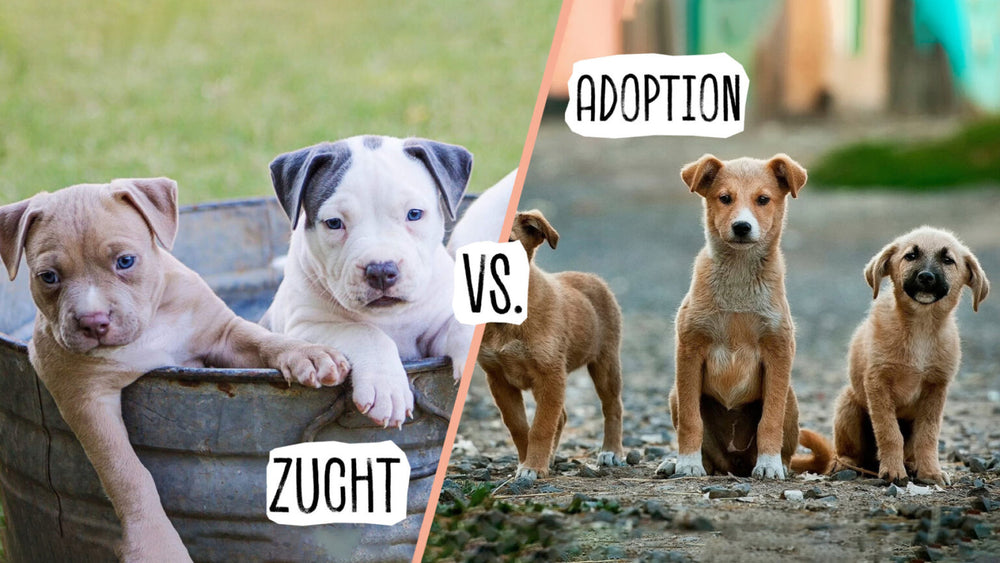
Welcoming a dog into the family is something very special – exciting and thrilling! The question of which dog is the best fit requires careful consideration. The same goes for the decision of where to get one from: a puppy from a breeder with a clean pedigree and papers? From one of the countless organizations that rescue poor souls from abroad, or perhaps from a German animal shelter? Future dog parents should carefully look into the various options before the new addition joins the family.
 Author: Alena
 Proofreader: Veronika

Some people want a puppy from a breeder with a verified pedigree and papers. A young dog that is well-socialized, less prone to illness, and has not yet had any bad experiences.
However, a few points must be considered here:Classic breeding follows strict guidelines(1), under which animals quickly fall outside the criteria. If the desired color tone is missed by a few shades, the pedigree animal becomes a throwaway product and, in the worst case, ends up as animal feed. But does being "too light" or "too dark" make an animal any less lovable? Cruel breeding practices are also an alarming keyword. Flat noses, through which hardly any air can pass(2); short tails that no longer allow for dog-typical communication; bulging eyes and crooked legs – in breeding, the focus is often on appearance and, naturally, profit, not the well-being of the animal. Some forms of breeding even mean physical harm to the animals: Pugs, for example, easily suffer from breathing difficulties due to their flat muzzles(3). Color variants like Blue Line or Merle are associated with such strong genetic mutations that illnesses are not uncommon: Deafness and small eyes leading to blindness occur frequently in Merle dogs(4), while dogs with the Blue Line look often suffer from incurable skin diseases(5). And all this despite the fact that cruel breeding is prohibited according to Section 11b of the Animal Welfare Act. However, vague wording, a lack of capacity among authorities, and a lack of follow-up enable these animal-welfare-violating practices(6).
As animal-loving dog owners, it is up to us to decide which animal we choose and what we turn away from. Because here, too, the following applies: Demand regulates supply.

Most dog owners have surely already heard of the illegal puppy trade(7): dogs are bred in Eastern Europe under catastrophic conditions and offered for sale on online portals – cute puppies from supposed hobby breeding. But in reality, these are mother dogs degraded to birthing machines that are forced to produce one litter after another while lying in their own excrement in cramped cages. Dog-appropriate food and medical care? Forget it! When they are no longer "good enough," they are disposed of...The males, on the other hand, are pumped full of hormones to be able to mate constantly under the influence of violence such as electric shocks or kicks(8).
And the puppies are separated from their mothers far too early (usually after two to four weeks(8)), which means they lack not only the important mother's milk but also the necessary socialization. Behavioral disorders and a weak immune system can be the result. Without the essential vaccinations, they are finally smuggled across the national border by car, which means death for some puppies. Others are seriously ill. The papers are either non-existent or forged(8). According to the EU, 50,000 puppies are traded illegally in European countries every month.
In the past, strikingly low prices raised suspicions. But today, dealers offer the puppies at the same prices as breeders. This makes it harder to avoid this trap and uncover illegal trade. Therefore, one should think carefully about where the new addition to the family should come from. Anyone who becomes aware of illegal traders should report them under this link in any case(9).

About350,000 animals(10) end up in one of the approximately 500 animal shelters in Germany every year, waiting there for a new home and a new family. Whether abandoned, left behind, too expensive, or not enough time – animals arrive here for a wide variety of reasons. But they all have one thing in common:They are lovable and deserve a second chance.They want to trade their cage for their own dog bed and their hardworking, yet busy caregivers for a person of their own who gives them undivided attention. Shelters house animals of all ages, colors, sizes, and temperaments. Therefore, there is a perfect companion for everyone.And that's not all: the animal caretakers know their protégés and can provide extensive help in choosing the right animal. This gives both owner and dog the chance to get to know each other and sniff one another out first. A great foundation for a future together!Would you like to look for "your" four-legged friend at a shelter near you? You can find an overview of animal shelters here(11).

Adopting from a German animal shelter is wonderful, and every animal deserves such an adoption. Yet, some people want to go a step further and provide a home to an animal from abroad. After all, animals in German shelters are relatively well off. They receive good food and medical care when they are sick. Furthermore, they get stimulation and affection from caretakers or volunteers. Animals abroad are in much worse conditions:On the streets, in overcrowded shelters, or in kill shelters, they fight for their survival every day.When the peak tourist season approaches, so-called "clean-ups" take place in holiday regions: stray animals are killed so as not to tarnish the cityscape(12). Then there are the animals in shelters that do not meet German standards. They are overcrowded, and there is only whatever food happens to be available. Even if it is just old bread. It even happens that the dogs eat each other. Sick and injured dogs walk around with no prospect of medical care. Anyone who has seen the conditions in such a shelter with their own eyes will never be able to shake those images.
The dogs in kill shelters, on the other hand, have only a certain amount of time (e.g., two weeks) to find a new home. If they don't, they must die. Even at the prime of their lives and in the best of health. Pictures of piles of dead dogs with the headline "...because no one wanted us" appear on social media time and again.A fate no animal deserves.Therefore, anyone wishing to save an animal from almost certain death should contact one of the countless animal welfare organizations found on the internet: many specialize in a specific country, some even in a specific breed. Here, too, the organization provides consultation, and the right dog will surely be found. Some of them are already in foster homes in Germany and can thus be met before adoption.And after a successful adoption, a new dog can move into the vacant foster spot, thus getting the chance to find a wonderful home as well.Even if taking in a dog from abroad requires more work and patience in some respects, it is worth it. They show their gratitude every day. And it is a true joy to take steps together and feel the successes.A unique relationship is formed.

Ultimately, everyone has to decide for themselves where a pet should come from. And the fact is that every animal deserves a dignified life. Regardless of where it comes from. Nevertheless, your choice supports certain structures, so the decision should be well considered.
The dogs of the VEGDOG pack come from abroad because animal welfare is of great importance not only to the brand, but also to every single member of the team. Each dog has its own story, which has certainly left its mark. But each of them is unique in its own way, and it is a true gift that they are part of our lives and our team.
So we ask ourselves: If there are so many dogs without a home or family that wish for a family, a warm home, and a full bowl, why do more animals need to be bred? Therefore, we would like to share this thought: Please consider that every dog from a breeder means that another dog stays on the street, in an animal shelter, or in a kill shelter.
SOURCES
1) VDH (n.d.): Breed Encyclopedia. <https://www.vdh.de/welpen/rasse>
2) Merkur (2019): Criticism of torture breeding in pets. <https://www.merkur.de/leben/tiere/kritik-an-qualzuchten-bei-haustieren-zr-11738464.html>
3) Planet Wissen (2020): Torture breeding in dogs. <https://www.planet-wissen.de/natur/tier_und_mensch/tierzucht/qualzuchten-100.html>
4) Planet Wissen (2021): Merle dogs – Beauty with a genetic defect. <https://www.planet-wissen.de>
5) PETA (2020): These 17 “pets” are torture breeds – characteristics and diseases. <https://www.peta.de/themen/qualzucht-haustiere/>
6) Deutscher Tierschutzbund e.V. (n.d.): Torture breeding in pets. <https://www.tierschutzbund.de/information/hintergrund/heimtiere/qualzucht/>
7) Vier Pfoten (n.d.): Stop illegal puppy trade. <https://www.vier-pfoten.de/kampagnen-themen/themen/heimtiere/hunde/illegaler-welpenhandel?fbclid=IwAR1yit9Xj1euCsZahbyFabNXQ7vdpBeYXr3qANQQoq-xRDoCLik22YGVxHM>
8) Deutscher Tierschutzbund e.V. (n.d.): Illegal puppy trade. <https://www.tierschutzbund.de/information/hintergrund/heimtiere/illegaler-welpenhandel/>
9) Vier Pfoten (n.d.): Reporting illegal puppy trade. <https://www.vier-pfoten.de/kampagnen-themen/themen/heimtiere/hunde/illegaler-welpenhandel/illegalen-welpenhandel-melden>
10) Deutscher Tierschutzbund e.V. (n.d.): Animal placement. <https://www.tierschutzbund.de/organisation/einrichtungen/zentrum-weidefeld/tiervermittlung/>
11) Deutscher Tierschutzbund e.V. (n.d.): Find animal shelters near you. <https://www.tierschutzbund.de/organisation/ueber-uns/tierheime/>
12) Planet Wissen (2017): Animals in shelters. <https://www.planet-wissen.de/natur/tier_und_mensch/tiere_im_heim/index.html>